
EMBA 21 Graduation Ceremony: Speech by Vjekoslav Majetić
04/02/2026
EMBA 21 Graduation Ceremony: Speech by Zrinka Bokulić
04/02/2026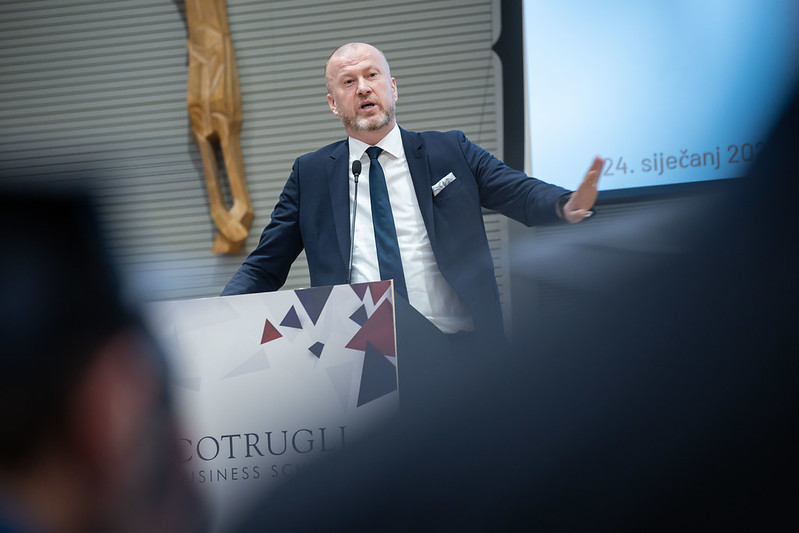
EMBA 21 Graduation Ceremony: Speech by Zoran Mabić
As part of the EMBA 21 Graduation Ceremony, Zoran Mabić, General Manager at Lesaffre Adriatic & Slovenia, delivered a speech during the diploma award ceremony. The speech is presented in full below.
Socrates once said, “Education is the kindling of a flame, not the filling of a vessel.”
I hope to ignite at least a small spark in the next five minutes by sharing my own story and the lessons I’ve learned from it, which also tie into the era of AI.
About 25 years ago, I was a Sales Representative at Sloboda Osijek, a large company with around 1,000 employees. I had two years of experience, and I shared the field with a colleague who was two years away from retirement.
One day, over coffee, we found ourselves discussing the most important traits and skills in life—those that bridge personal and professional success and satisfaction.
He told me, “After much thought and experience, I’ve distilled it down to two key traits. It’s a bit late for me to implement them fully, but I’d like to share them with you because I truly believe they’ll help you if you make them a habit.”
Habits are crucial. And being young and eager, I was all ears, knowing how intelligent and experienced he was.
He said, “The first is extreme curiosity—not the kind that’s interested in gossip or trivial matters, but genuine professional and educational curiosity. From microeconomics within companies to macroeconomic trends. If you’re extremely curious, you’ll always find the best path for your growth.
The second is boundless positive energy, which includes passion and, as Americans say, ‘drive,’ but it’s much more than that. It’s not just seeing the glass as half full—that’s not positive enough. Even if something is 95% negative and only 5% positive, focus on that 5% and learn how to move forward and quickly get back up if you fall. This greatly contributes to the harmony between personal and professional life, as well as individual health. It’s not about being intellectually blind to the negative, but about viewing everything through a positive lens while being aware of the whole picture.”
Now, 25 years later, after completing various educational programs, including two postgraduate degrees (one of which is this EMBA), and holding various managerial roles with about 10 years of CEO experience, I’ve come to the same conclusion. I’ve come full circle and completely agree with what he told me back then. It reminds me of Cicero’s saying: “There is no wisdom without experience.”
What does this anecdote have to do with you and the era of AI, which is making a quantum leap unprecedented in history? A lot. These values are timeless. They were relevant in Socrates’ time, 25 years ago, and they will remain relevant in the age of AI.
These values provide an advantage in two areas that will align with AI: the speed of adaptation, i.e., the ability to quickly acquire new knowledge and skills, and the second is that only the best experts in each field will have an easier future.
What about those in between, the majority? I don’t know. I doubt anyone can predict it today. If we look at the greatest minds of the last two centuries and their projections of the future, with a 20-year hindsight, over 90% of their predictions missed the mark in terms of what would happen and when.
There are simply too many variables. Take a simple example from everyday life: when you walk into a store and see thousands of products, over 35,000 of them. On average, each product has about 8,000 different variables! How, then, can we react and know if we’ve made the right choice when we freeze prices and how that impacts the overall picture? Now imagine the AI-driven future, where the number of variables is exponentially higher.
Personally, I believe the future, precisely because of its unpredictability, will be better than the past. Don’t fall into negative spirals. Always view things through a positive lens, and your chances of finding the right solutions will increase dramatically.
I don’t see any flames yet, but it seems like there’s a bit of smoke rising from the back rows.
Thank you, and I wish you all the best in a positive future!