


The Sun Also Rages
13/04/2026
A NEO Cotruglian Meditation on Retardmaxxing
20/04/2026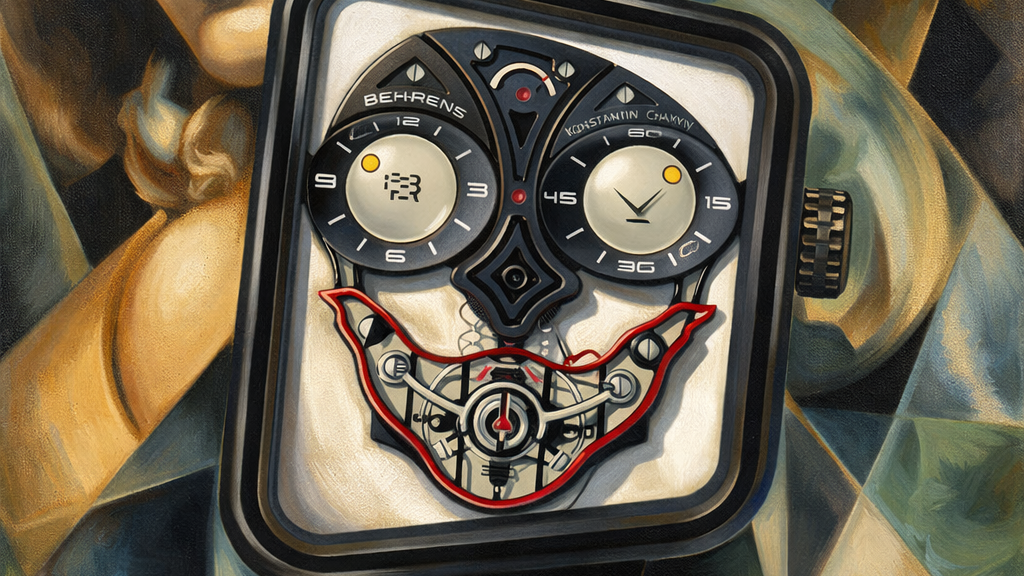
A NEO Cotruglian Meditation on Hormuz
For those who suspect that hitting quarterly targets is not the same as understanding what time you are living in.
I. On Objects That Think for Us
There is a mechanical watch called the Ace of Hearts. A collaboration between BEHRENS and Konstantin Chaykin — two houses that share no aesthetic ancestry.
BEHRENS brings asymmetrical audacity.
Chaykin brings the Joker spirit.
And then, without explanation, the watch absorbs the sculptural grammar of Han Dynasty ceramics.
The result is not a synthesis. It is an emergence.
Hours and minutes appear as two eyes. A red heart-shaped seconds hand traces a millstone path — patented, whimsical, mechanically exact. Forty-six hours of power reserve. Eleven patents. Through the transparent case back: brush-finished plates, mirror-polished pivots, chamfers cut by hand.
But I did not begin with this watch because of its specifications.
I began with it because it embodies what NEO Cotruglian philosophy calls orchestrated emergence — the capacity to hold radically different excellences together, not through compromise, but through a higher coherence that none of the parts could produce alone.
Can asymmetry live with precision? Can playfulness cohabit with ancient discipline?
The Ace of Hearts says yes. And the next five months will demand exactly that capacity from you.
II. What Ragusa Knew That Empires Forgot
Ragusa — today’s Dubrovnik — survived for centuries wedged between the Ottoman Empire and Venice, later between Austria, Russia, and Napoleonic France. It had no serious army. Its population was tiny.
What it had was a different relationship to time.
Here is the distinction that separates our and Ragusa greatest Cotrugli from Machiavelli — and it is the most consequential distinction in the history of Mediterranean strategic thought.
Machiavelli, writing from Florence in 1513, saw the world through the eyes of the prince. His central concern was the acquisition and maintenance of power. Time, for Machiavelli, is the enemy — fortuna — a force to be seized before it turns. “Strike while the iron is hot” is a Machiavellian sentence. The prince thinks in events: the decisive campaign, the spectacular coup, the first week of the war.
Cotrugli, writing from Ragusa fifty-five years earlier, saw the world through the eyes of the merchant. His central concern was not power but continuity — the preservation of trade as a condition for human flourishing. Time, for Cotrugli, is not the enemy. It is the medium in which trust compounds. The merchant does not seize the moment. The merchant endures through the duration.
The Ottoman sultan thought like Machiavelli — optimize for the opening blow.
The Venetian doge thought like Machiavelli — optimize for the first decisive battle.
Ragusa thought like Cotrugli — optimize for what happens after the admirals go home. When the sea is still dangerous. When insurance rates remain punitive. When merchants still need to move pepper, silk, and grain through contested waters — and someone must guarantee the contracts.
Ragusa survived not because it was strong. It survived because it was structurally necessary.
This is Cotrugli’s deepest insight, and it inverts Machiavelli entirely: when you cannot win by force, you survive by becoming the condition under which others can still function. The prince asks: how do I dominate? The merchant asks: how do I become indispensable?
Cotrugli did not say trade was about profit. He said trade exists first for preserving humankind, and only then for personal gain. That is not ethics bolted onto commerce. That is commerce understood as a form of care. And care, unlike power, does not decay with time. It accumulates.
III. Hormuz
Now transpose.
The Strait of Hormuz carries roughly 20 million barrels of oil per day — one-fifth of global consumption. If it becomes persistently unsafe — not formally blockaded, but commercially impaired through vessel avoidance, insurer retreat, and intermittent closures — then we are not facing a logistics disruption.
We are facing the moment where all logic breaks.
Machiavelli’s world is bilateral: prince against prince, state against state. But Hormuz is not a bilateral problem. It is a networked problem, an exponential problem, an orchestrated problem.
It is, in other words, a NEO problem — and NEO problems require Cotruglian answers.
Networked. A single security event in the Gulf does not simply delay a tanker. It triggers a cascade of reputation effects, insurance re-ratings, and contract renegotiations that propagate across supply chains within days. Machiavelli understood bilateral leverage. He did not understand — could not have understood — network contagion. In a NEO world, no actor is isolated. Every disruption is everybody’s disruption.
Exponential. A two-week disruption can be absorbed. A five-month disruption transforms the structure of possibility. The difference between week one and month six is not arithmetic. It is the difference between a wound and a chronic condition. Between an event and a new reality. Machiavelli optimized for the event. Cotrugli optimized for the duration. In exponential environments, duration wins.
Orchestrated. No single actor — no CEO, no government, no alliance — can resolve this alone. What is required is emergent coordination: insurers, flag states, port authorities, competitors, and neutral intermediaries acting without a conductor.
Machiavelli would see this as a weakness — the absence of a prince.
Cotrugli would see it as the natural state of trade: self-organization born of mutual necessity.
Most executives are trained in Machiavellian reflexes — linear, hierarchical control. That works when the sea is calm. It becomes a liability when the sea stops feeling safe — because feeling safe is the precondition for every contract ever signed.
IV. The Wolf and the Sheepdog — or, Machiavelli vs. Cotrugli in Practice
In a prolonged disruption, two metabolic patterns emerge. They are not just business strategies. They are philosophical commitments.
The Wolf operates on Machiavellian logic. Closure is an extraction opportunity. Break long-term contracts. Chase spot prices. Cut corners on crew safety. The wolf produces visible gains in week one — the prince seizes fortuna — and then watches trust evaporate, partners defect, and systemic fragility compound. The wolf’s error is the prince’s error: it mistakes the price of a relationship for its value. It optimizes for the event and loses the duration.
The Sheepdog operates on Cotruglian logic. It absorbs short-term costs to preserve the relational infrastructure. It shares rerouting burdens. It invests in reputation not as branding but as structural capital — the kind that appreciates precisely when everything else depreciates.
Here is what five months reveal: the wolves are exhausted and alone. The sheepdogs still have counterparties who answer their calls.
This is not sentimentality. This is the NEO Cotruglian realism that Machiavelli never reached. In a networked, exponential, orchestrated environment, trust is the only asset class that gains value under stress. Everything else — efficiency, speed, leverage — is procyclical. Trust is countercyclical. And countercyclical assets are what you need when the cycle breaks.
Machiavelli was right about one world — the world of princes, of bilateral power, of the decisive blow. But that world is shrinking. The NEO world is expanding. And in this world, the sheepdog outperforms the wolf not by quarter, but by era.
V. Three Demands of the Sixth Month
If Hormuz remains commercially impaired through autumn, the questions that matter shift entirely.
Not: Who struck hardest this week? — That is Machiavelli’s question.
But: Who can still move cargo in the sixth month? — That is Cotrugli’s.
Not: Which alliance is winning?
But: Which counterparties still trust you enough to co-sign a bill of lading?
Not: How do we optimize for efficiency? But: How do we build optionality before we know what we need it for?
Three imperatives follow — each one Cotruglian, each one a direct inversion of Machiavellian instinct.
First: recover the merchant’s temporal imagination. Stop managing for the quarter. Start managing for the siege. Build inventories before they look rational. Pay for second routes before the first one fails. Stress-test liquidity against freight and fuel shocks — not just demand softness. The prince seizes the moment. The merchant outlasts the moment. In a five-month siege, outlasting is the only strategy that compounds.
Second: treat verification as civilizational infrastructure. In a world of sanctions, spoofed AIS signals, dark fleets, and AI-generated documents, the firm that can prove provenance — who shipped what, through where, under whose authority — holds an advantage that accountants classify as administrative and NEO Cotruglian thinkers recognize as foundational. When no one knows what is true, the entity that can verify becomes indispensable. This was Ragusa’s role in the fifteenth century. It remains unclaimed in the twenty-first.
Third: resist the seduction of purity. Machiavelli admired decisive alignment — pick a side, commit fully, dominate. Cotrugli admired something harder: the capacity to remain useful to all sides without being owned by any. Ragusa survived because it was never fully aligned with any empire. A Cotruglian calls it optionality as an operating system — the discipline of remaining open when every instinct screams for closure.
VI. The Convergence
The Ace of Hearts exists because someone believed that asymmetry, playfulness, and ancient craft could emerge into something that works — not despite its contradictions, but through them.
The next five months demand the same NEO Cotruglian conviction. Not about watches. About supply chains, alliances, insurance markets, and the quiet, unglamorous labor of keeping trade alive when the sea no longer feels safe.
Cotrugli wrote that a merchant should remain stable, with the spine of a donkey for perseverance.
That image is not accidental. He chose the donkey — not the lion, not the eagle.
Machiavelli would have chosen the lion. Or the fox. Animals of dominance and cunning. Cotrugli chose the animal that carries, that endures terrain, that does not require glory. The animal whose intelligence is patience.
This is the yin and yang of Mediterranean strategic thought. Machiavelli gives you the first week. Cotrugli gives you the sixth month. The prince gives you power. The merchant gives you a duration.
The question is not whether Hormuz will reopen. It will. The question is what kind of firm — what kind of mind — you will have built by the time it does.
Machiavelli will tell you to seize Monday morning.
Cotrugli will ask you: can you still be standing by Friday — of the fifth month?
Which question is yours?