


Seeing the Future: What Vanguard Leaders Can Learn from Israel’s Ro’im Rachok
07/04/2026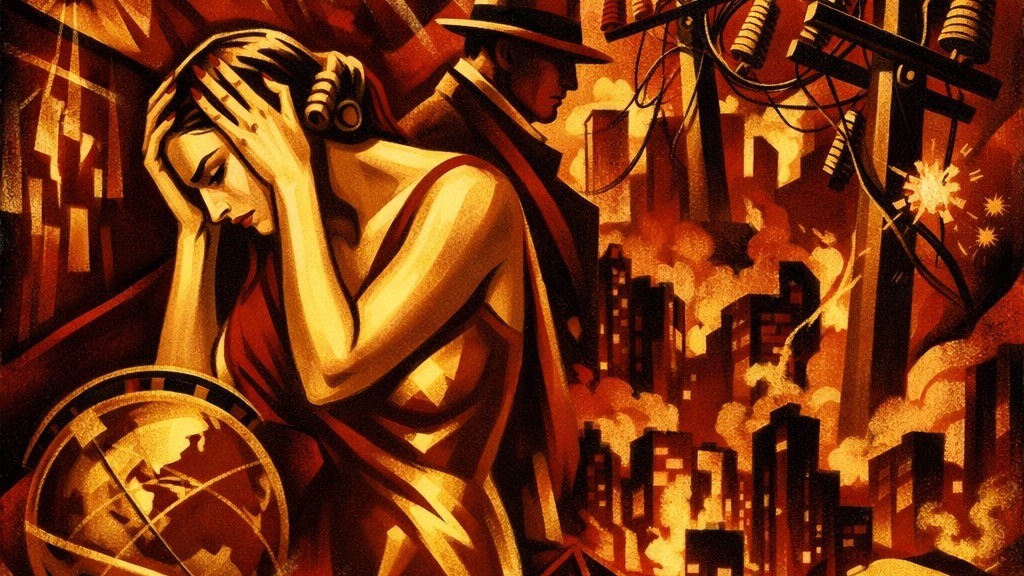
In 1859, a celestial cataclysm struck Earth, turning night into day and frying the “Victorian Internet.” A Carrington Event today wouldn’t just be inconvenient. It would be the most expensive natural disaster in human history.
At 11:18 a.m. on Thursday, September 1, 1859, a wealthy amateur astronomer named Richard Carrington was doing what he did best: staring at the sun. In the private observatory atop his country estate just outside London, the 33-year-old brewer’s son cranked open the dome’s shutter, aimed his brass telescope at a constellation of unusually large sunspots, and began to draw. He was a meticulous man, perhaps a bit boring. He had no idea he was about to witness the birth of a monster.
Suddenly, out of the black spots, two patches of “intensely bright and white light” erupted, bloomed, and began to fade. It was a solar flare—the first ever recorded by human eyes. Five minutes later, the fire vanished. Carrington, ever the careful scientist, noted the time and waited for a corroborating witness. He later wrote, “one swallow does not make a summer.” He couldn’t know that the cosmic swallow he’d just seen was actually a dragon.
The dragon’s breath—a colossal cloud of magnetized plasma known as a coronal mass ejection (CME) carrying the energy of 10 billion atomic bombs—was already hurtling through space at millions of miles per hour, straight toward Earth.
The Night the Sky Caught Fire
Just under 18 hours later, the dragon arrived. It slammed into our planet’s magnetic shield like a cymbal crash in the void, unleashing a geomagnetic superstorm now known as the Carrington Event—still the most intense ever recorded.
What happened next, was “gonzo.”
The sky turned to neon. Brilliant auroras, usually confined to the polar regions, blazed south past Cuba, lit up the gold fields of Australia, and turned the skies over Rome a deep, bloody red. The heavens over the Rocky Mountains grew so bright that sleeping miners in Colorado woke up, cooked breakfast, and started their shifts, convinced it was dawn. Birds began to chirp at 1 a.m. In New York City, you could read a newspaper on the street by the unearthly glow. People, quite understandably, thought the world was ending.
Meanwhile, the planet’s electrical infrastructure—the so-called “Victorian Internet” of telegraph wires—went completely haywire. Wires snapped. Sparks showered from machines, setting paper tapes on fire. In Washington, D.C., telegraph operator Frederick W. Royce received a severe shock when his forehead grazed a ground wire, and witnesses reported an “arc of fire” jumping from his head. In Pittsburgh, the currents surging through the lines were so powerful that platinum contacts began to melt, and “streams of fire” poured from the circuits.
And yet, amidst the chaos, a miracle of the “new economy” emerged. In Boston, telegraph operators found their batteries completely useless. But the atmosphere itself was so saturated with auroral current that they simply unplugged them—and kept on working. For over an hour, they sent messages back and forth between Boston and Portland, Maine, powered solely by the wrath of a star 93 million miles away.
The Sound of the Inevitable
Here is the truth: it wasn’t a one-off. It is a rhythm. Our star operates on an 11-year cycle, currently ramping up toward its solar maximum. And according to a 2025 UK government estimate, there is a 5 to 25 percent chance of a severe space weather event by 2030. A separate analysis suggests a roughly 12% probability of a Carrington-level event in the next decade.
It’s not a question of if, but when. And the next time, we won’t just be frying some telegraph keys in Pittsburgh.
In 1859, the global economy was largely mechanical and agricultural. The only things that got fried were wires and the nerves of a few operators. Today, our entire civilization is a delicate, humming, electromagnetic soufflé..
There’s still a lot to learn.
Earth’s own natural defenses are not what they used to be. Our magnetic field, the invisible shield that deflects much of the solar wind, has weakened by an estimated 25 to 30 percent since Carrington’s time. We are, in a very real sense, running around a thunderstorm with a shorter and more tarnished lightning rod.
Richard Carrington died in 1875 at the age of 49, long before anyone understood the true power of what he saw that September morning. His discovery, born of a quiet, privileged life of Victorian observation, became one of the foundational myths of our precarious digital age. He saw the dragon breathe. The question that haunts our hyper-connected, just-in-time, battery-powered world is a simple, chilling one: what happens when the dragon breathes again?
There’s still a lot to learn.
If a Carrington-level event happened today, it wouldn’t just knock out some power lines. It would effectively decapitate the entire global AI infrastructure—collapsing its energy, connectivity, and silicon brain simultaneously.
Here is a scenario breakdown of how this would unfold, from initial errors to a potential “Digital Dark Age.”
Phase 1: Immediate Impact (First 24-72 Hours)
This phase is about “silent corruption”—the storm breaking the technology from the inside out before the lights even go out.
- The “1,150% Failure Spike”: The first sign of trouble would be a catastrophic increase in AI malfunctions. In 2025, a study found that during geomagnetic storms, AI failure rates skyrocketed by 1,150% across platforms like OpenAI and Google. A Carrington-level event would likely push this to 100% failure, as logic breaks down across the board.
- Bit-Flip Explosion (Hardware Rot): The surge of cosmic radiation would cause “Single Event Upsets” (SEUs) at an unprecedented scale. Bits would randomly flip inside server CPUs and GPUs, turning a “0” to a “1”. This would turn AI training into garbage-in, garbage-out and cause deployed inference servers to produce nonsensical outputs.
- Training Data Corruption: In a nightmare scenario, if an AI was in the middle of a training run during the storm, these bit-flips could become permanently encoded into the model’s core weights. You could end up with a flagship AI that is permanently psychotic or broken from the moment it is “born”.
Phase 2: Mid-Term Collapse (1 Week to 6 Months)
Once the initial radiation passes, the infrastructure fails, turning a digital glitch into a physical collapse.
- The Power Grid Dies (Months of Darkness): Geomagnetically Induced Currents (GICs) will flow into high-voltage transformers, melting their copper windings and destroying them beyond repair. Because these massive transformers take 12-24 months to manufacture and install, the power grid in large regions (like the US Midwest/East Coast) would remain offline for months.
- Data Center Meltdown: Without grid power, data centers would switch to backup diesel generators. However, a Carrington event doesn’t just knock out power; it destroys the grid. Fuel supplies would run dry in days, and refineries would be offline. As the generators fail, the cloud goes silent. ChatGPT, Google, and AWS vanish.
- Satellite Apocalypse: The storm would be devastating in orbit. The Earth’s atmosphere would heat up and expand, creating 4x normal drag on Low Earth Orbit satellites. Without power for orbital adjustments, hundreds of satellites would begin to burn up in the atmosphere within weeks. GPS, communications, and Earth-imaging would be gone.
Phase 3: The Long Tail (Years)
If the grid is down for months and satellite infrastructure is destroyed, the recovery phase becomes a long-term catastrophe for AI development.
- The Semiconductor Wall: AI chips (GPUs) require the world’s most complex supply chain. Without a functioning global grid, shipping, or logistics, the fabrication of new chips halts completely. Existing hardware would degrade or be destroyed in the blackouts.
- The Knowledge Silos: Without the internet, we revert to localized data. The “wisdom of the crowd” that trains our best models disappears. Development would be limited to whoever has surviving hardware and isolated power.
- The Urgent Window to Prepare: We are currently in a high-risk period. The Sun is in an active phase, and we narrowly missed a massive storm in 2012. The question is not if, but when.
The irony is chilling. We are rushing to build Artificial General Intelligence (AGI) to solve our biggest problems, yet a single burp from our local star (the Carrington Event) could wipe out the computing substrate needed to run it. If we don’t harden our grids, satellites, and data centers, the “Singularity” might not be an explosion of intelligence—it might be a silent, dark collapse.